
Main Courses
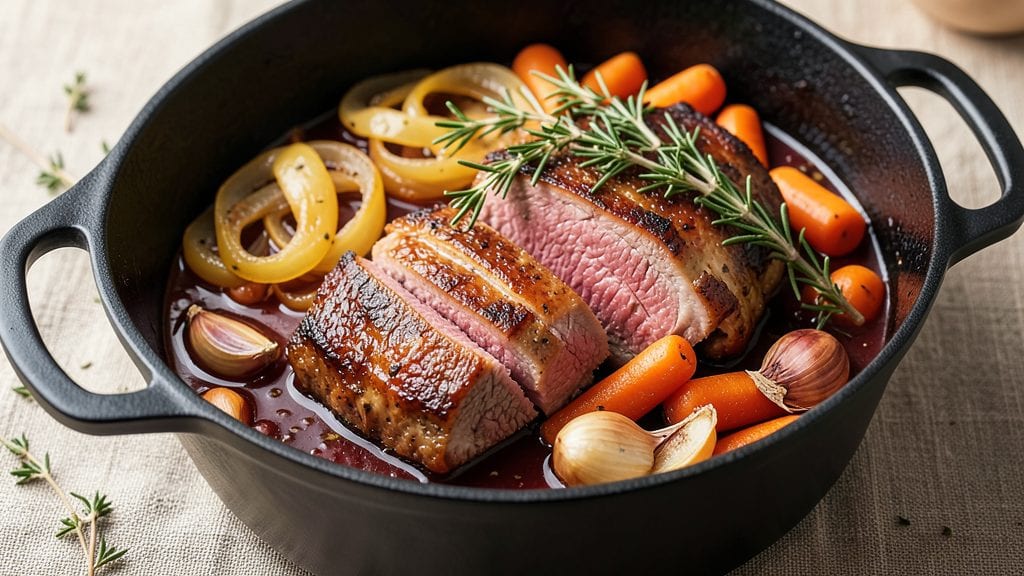
A pot rost recipe mastered turns even the toughest cuts into luxurious, fall-apart tenderness through hours of slow simmering and aromatic spices. The secret lies in proper marinating, precise browning, and patient slow cooking—each step building depth that elevates humble ingredients into a showstopping centerpiece.
After years of perfecting this technique, I’ve developed a method that delivers restaurant-quality results without requiring hours of active prep.
This recipe begins with a flavorful marinade that tenderizes the meat while infusing it with aromatic herbs and spices. Browning the roast in a hot Dutch oven creates a deep, caramelized crust that forms the foundation for a rich gravy later on.
The slow cooking process—typically 3 to 4 hours at 325°F—allows the meat to become fork-tender while absorbing all the surrounding flavors into a velvety sauce.
By the time you serve it, you’ll have a pot roast with perfectly tender meat, a glossy gravy that coats every bite, and sides like roasted vegetables or mashed potatoes that soak up every last drop.
The aroma alone will have everyone anticipating dinner, and the first bite will confirm why this classic dish remains a staple in home kitchens worldwide.
Whether you’re cooking for a family gathering or a cozy weeknight meal, this pot roast delivers comfort and satisfaction. The method scales easily, and leftovers reheat beautifully, making it a practical choice for busy schedules.
Let’s get started on creating a dish that feels like a warm embrace on a chilly evening.
Ingredients for pot rost
Sixteen essential ingredients transform tough beef into velvety perfection through slow-cooked harmony.
| Ingredient | Amount | Notes |
|---|---|---|
| Beef Chuck Roast 🥩 | 4 lb | Well-marbled, 3-4 inches thick |
| Yellow Onions 🧅 | 2 whole | Medium-sized, sliced into wedges |
| Carrots 🥕 | 4 whole | Medium-sized, peeled and halved |
| Garlic Cloves 🧄 | 8 cloves | Fresh, smashed but not minced |
| Fresh Thyme Sprigs 🌿 | 4 whole | Stems intact for easy removal |
| Fresh Rosemary Sprigs 🌿 | 2 whole | Woody stems removed |
| Beef Broth 💧 | 3 cups | Low-sodium, high-quality |
| Red Wine 🍷 | 1 cup | Dry, medium-bodied |
| Tomato Paste 🍅 | 2 tbsp | Canned, unsweetened |
| All-Purpose Flour 🌾 | 2 tbsp | For gravy thickening |
| Diamond Crystal Kosher Salt 🧂 | 1 ½ tsp | For seasoning and gravy |
| Freshly Ground Black Pepper 🌶️ | 1 tsp | Coarse grind preferred |
| Unsalted Butter 🧈 | 2 tbsp | Cold, for gravy finish |
| Olive Oil 🫒 | 2 tbsp | Light, for searing |
The beef chuck roast is non-negotiable—its marbling ensures melt-in-your-mouth tenderness. Butcher shops often carry superior cuts, but high-quality supermarket roasts work if labeled 'well-marbled.' Avoid anything with grayish edges or excessive lean. For optimal results, trim excess fat but leave a thin layer for flavor. The onions and carrots should be fresh, firm, and free of soft spots—Trader Joe's bulk bins offer excellent value for these staples. Fresh herbs like thyme and rosemary add aromatic depth; Whole Foods sells pre-bundled sprigs for convenience, but individual stems allow better flavor control during cooking.
Substitutions must preserve balance. No red wine? Beef broth with a splash of balsamic vinegar maintains acidity. Fresh herbs unavailable? Dried thyme at one-third the amount suffices, though texture differs. For tomato paste, San Marzano crushed tomatoes work in a pinch (reduce by half). The flour should be all-purpose, but cornstarch creates a glossier gravy if preferred. Salt measurements are precise—Diamond Crystal's larger crystals mean using slightly less than table salt. Black pepper should be freshly ground; pre-ground loses potency within weeks. Butter for the gravy must be cold to create proper emulsification.
Leftovers reheat beautifully—simmer gently with a splash of broth to restore moisture. Store in airtight containers for 4-5 days; freeze portions for up to 3 months. The gravy thickens upon cooling, so thin with additional broth if needed. For meal prep, double the recipe and portion into individual containers. The Dutch oven becomes your best friend—its heavy base distributes heat evenly, essential for even cooking. When reheating, cover tightly to retain aromatics and prevent drying.
Why You'll Love This Recipe
- Carrot-Garlic Magic: Sweet carrots caramelize right into the meat, while the garlic and thyme infuse that deep, savory aroma. It’s the kind of flavor that makes you pause mid-bite—like a hug for your taste buds.
- Leftover Goldmine: This recipe begs for seconds, and the leftovers? Even better cold in sandwiches or reheated for hash. I’ve fed a crowd with one roast—no waste, just satisfaction.
- Budget Hero: A chuck roast stretches farther than you’d think, especially with onions and carrots bulking it up. Honestly, it’s my go-to when I need a filling, hearty meal without breaking the bank.
Step-by-step instructions for pot rost recipe
This method transforms tough beef into melt-in-your-mouth perfection through precise timing and layering of flavors.
Sear the Beef Chuck Roast for Deep Flavor Foundation
Pat the 4 lb beef chuck roast completely dry with paper towels—this ensures maximum browning. Heat 2 tablespoons olive oil in a Dutch oven over medium-high heat until shimmering. Place the roast fat-side down and sear undisturbed for 8-10 minutes until a deep golden-brown crust forms.
Flip the roast and sear the other side for another 6-8 minutes. The goal is to develop a rich, caramelized crust that will carry through the slow cooking process. Remove the roast and set it aside on a plate, allowing the rendered fat to remain in the pot—this fat becomes the flavor base for your gravy.
Build the Aromatic Base with Vegetables and Herbs
In the same Dutch oven, add the sliced 2 whole yellow onions and 4 whole carrots (halved lengthwise). Cook over medium heat for 5 minutes, stirring occasionally, until the onions soften and begin to caramelize. Add the 8 cloves smashed garlic cloves, 4 whole fresh thyme sprigs, and 2 whole fresh rosemary sprigs, stirring for 1 minute until fragrant.
Sprinkle the roast with 1.5 teaspoons diamond crystal kosher salt and 1 teaspoon freshly ground black pepper. Return the roast to the pot, fat-side up, and pour in 1 cup red wine. Scrape up any browned bits from the bottom—these contain concentrated flavor. Let the wine simmer for 3-4 minutes until reduced by half.
Slow Cook Until Fork-Tender with Liquid Layers
Stir in 2 tablespoons tomato paste and cook for 2 minutes until it darkens slightly. Pour in 3 cups beef broth, ensuring the roast is fully submerged. Bring to a gentle simmer, then reduce heat to low. Cover the pot and transfer to a preheated 300°F oven (or maintain on the stovetop at the lowest setting).
Cook for 3 hours, then check the internal temperature with a meat thermometer. The roast should register 190-195°F—this is where collagen breaks down into gelatin, creating that signature pot rost tenderness. If not yet tender, continue cooking for another 30-60 minute increments until probe-tender.
Thicken the Gravy for Rich Finish
Remove the roast and transfer it to a cutting board. Tent loosely with foil and let rest for 15 minutes. Skim excess fat from the cooking liquid (leave about 2 tablespoons). Sprinkle 2 tablespoons all-purpose flour over the liquid and whisk vigorously to combine. Cook over medium heat for 3-4 minutes until the gravy thickens to a velvety consistency.
Stir in 2 tablespoons cold unsalted butter and taste. Adjust seasoning with additional salt and pepper if needed. The gravy should coat the back of a spoon smoothly—this is your signature element that elevates the dish from simple roast to restaurant-quality pot rost.
Carve and Serve with Masterful Presentation
Slice the roast against the grain into ¼-inch thick pieces. Arrange on a warm platter and ladle the thickened gravy generously over the top. Garnish with additional fresh thyme sprigs for visual appeal and a final burst of aroma.
Serve immediately with the braised vegetables and crusty bread to soak up every last drop of that luxurious gravy. The result should be fork-tender beef with layers of wine, herb, and caramelized flavors in every bite—proof that slow cooking transforms humble ingredients into something extraordinary.
Pro Tips For Making Pot Rost
- Brown the Roast First: That crust on the beef isn’t just for looks—it’s where all the flavor hides. Sear the roast in a hot pot with oil until it’s deep brown on all sides before adding liquids. I used to skip this, and my pot roast always tasted like it needed more seasoning.
- Cut Onions in Chunks: No one wants to bite into a whole onion. Roughly chop the yellow onions into 1-inch pieces—they’ll soften beautifully and blend into the sauce without turning to mush. (Yes, even if it looks uneven—this isn’t a garnish contest.)
- Don’t Overcrowd the Pot: If you pack the roast and veggies in too tight, they’ll steam instead of caramelize. Start with the roast and onions in one layer, then nestle carrots and garlic around it. I learned this the hard way when my first batch turned out soggy.
- Deglaze with Red Wine: After browning the meat, splash in a ½ cup of red wine (or broth if you’re skipping alcohol) and scrape up those browned bits from the bottom. That’s where the flavor lives, and skipping it means missing out on the richest part of the sauce. (No wine? A splash of vinegar works in a pinch.)
Creative variations of this pot rost
French Beef Bourguignon
Transform your pot roast into a classic French beef bourguignon by adding 1 cup pearl onions (peeled and blanched), 8 oz mushrooms (sliced), and 1 cup red wine (like Côte du Rhône).
Deglaze the Dutch oven with the wine after searing, then braise for 3 hours at 325°F. Finish with 2 tbsp Dijon mustard and fresh parsley for a restaurant-worthy twist. 🍷
Italian Osso Buco
For an Italian-inspired osso buco, use a 3-4 lb crosscut veal shank instead of beef. Sear the shank until deeply browned, then add 1 cup tomato passata, 1 tsp fennel seeds, and 2 sprigs bay leaf.
Slow-cook for 3 hours at 325°F, then finish with a splash of white wine and gremolata (lemon zest + parsley + garlic). Serve with risotto for a cozy meal. 🌿
Lamb Pot Roast
Swap beef for a 4 lb lamb shoulder (bone-in for extra flavor). Marinate overnight in 2 tbsp olive oil, 1 tbsp harissa paste, 1 tsp ground cumin, and 1 tsp smoked paprika.
Sear and slow-cook for 3.5 hours at 300°F. Finish with a splash of rosemary-infused olive oil and serve with minted couscous. 🐑
Spicy Korean-Inspired
Add a Korean twist with gochujang (Korean chili paste). After searing, stir in 2 tbsp gochujang, 1 tbsp soy sauce, and 1 tbsp honey with the wine.
Cook for 2.5 hours at 325°F, then finish with sesame seeds and sliced green onions. Serve with steamed rice for a bold, umami-packed dish. 🌶️
Vegetarian Mushroom Pot
For a hearty vegetarian version, use 2 lbs portobello mushrooms (halved) and 1 lb extra-firm tofu (pressed and cubed). Sauté mushrooms until golden, then add 1 cup vegetable broth, 2 tbsp soy sauce, and 1 tsp smoked paprika.
Simmer for 2 hours until tender. Garnish with fresh thyme and serve with mashed potatoes. 🌱
Smoky BBQ Pot Roast
Infuse smoky flavors by adding 2 tbsp BBQ rub (like Montana BBQ Company) to the seared roast. Use 1 cup apple cider instead of wine, and add 1 tbsp brown sugar to the braising liquid.
Slow-cook for 3 hours at 325°F, then finish with a drizzle of hickory-smoked maple syrup. Serve with cornbread for a Southern-inspired meal. 🔥
Nutrition facts
Frequently asked questions
What's the best cut of beef for a pot roast?
A beef chuck roast is ideal—its marbling ensures tender, flavorful meat when slow-cooked. Look for a 3-4 lb cut that's 3-4 inches thick for even cooking. Chuck roasts are budget-friendly and packed with connective tissue that melts into gelatin during slow cooking.
Can I make pot roast on the stovetop instead of the oven?
Yes! After searing, cover the pot and simmer on low heat for 3-4 hours, adding water or broth as needed to keep the roast submerged. The key is maintaining a gentle simmer—never a rolling boil—to prevent tough meat. A heavy-bottomed pot helps distribute heat evenly.
Why does my pot roast turn out tough instead of tender?
Overcooking or high heat are the usual culprits. Use a meat thermometer—aim for 190-195°F internal temp. Never rush the process; slow cooking breaks down collagen. Also, ensure the roast is fully submerged in liquid and avoid peeking under the lid (which releases steam and extends cooking time).
How do I make the gravy thicker without flour?
Try a roux (equal parts fat and flour cooked until golden) or cornstarch slurry (1 tbsp cornstarch + 2 tbsp cold water). For a gluten-free option, whisk in 1 tbsp arrowroot powder with cold liquid. Simmer until thickened, then stir in butter for richness. The gravy should coat the back of a spoon smoothly.
Can I prepare pot roast ahead of time?
Cooked pot roast reheats beautifully. Store leftovers in an airtight container for 4-5 days in the fridge or freeze for 3 months. To reheat, simmer gently with a splash of broth until warmed through. The flavors actually deepen overnight, making it perfect for meal prep.